
Blog
In a Time of War
An update from our staff and the National Institutions: March 2026

In a time of war, the work of our staff in Israel’s National Institutions is more important than ever. In early March Gidi Aizen, Vice Chair of KKL, joined Chair Eyal Ostrinsky on a visit to Be’er Sheva, where an Iranian rocket strike caused extensive damage and forced hundreds of residents from their homes. They met with Mayor Rubik Danilovich and visited the Conservative congregation Eshel Avraham, which was also badly damaged. Following the visit, the KKL Board approved an emergency aid package for Be’er Sheva and Beit Shemesh, the two cities hardest hit during the war.
The Board also adopted two important resolutions. The first was a humanitarian aid package for the Druze community in Syria, which is facing severe persecution by the regime. This is a moral duty, an important expression of the alliance between Jews and Druze and a historic KKL support in a non-Jewish sector.
The second was approval of KKL’s annual budget. With the involvement of Gidi and our team, Eyal presented a budget that reflects our values and priorities, including a 30% increase in KKL support for Reform Judaism in Israel and around the world, most of which will go towards enhancing leadership and pre-army programmes.
The Jewish Agency is also actively assisting those impacted by the current war.
Yaron Shavit, Deputy Chair of the Executive of the Jewish Agency, met with evacuees from Tirat HaCarmel. Among those displaced is “Anna” (a pseudonym), a single mother of four. Her eldest child is serving in the army. Anna is the sole provider for her family and works as a bus driver in Haifa, where she has been recognized as an outstanding employee.
On the first day of the war, the rented apartment where she and her children lived was struck and damaged by a missile. Now, without a home and unable to work during the ongoing war, Anna has received initial emergency assistance from the Jewish Agency through its Victims Fund.

At the World Zionist Organisation, the Department for Irgoon and Relations with Israelis Abroad, headed by Yair Lootsteen, has continued to operate at almost full capacity. Despite the danger of traveling on open roads during air-raid alerts, the department’s staff commute to its offices at the National Institutions’ complex in Jerusalem by private car and public transport from towns and cities such as Hod Hasharon, Rishon LeZion and Modiin.
“We are proud that four of the department’s employees have five children currently serving on active duty in the IDF!!” says Yair, “A combat medic in Golani, currently in Lebanon, a major serving as an operations officer at the Kirya in Tel Aviv, an information security officer at an Air Force squadron, and two relatively fresh recruits: in the communications and cyber command and a female recruit in the Air Force.”
There is also the personal impact felt by our staff. Ronit Boytner, Arzenu representative on the KKL-JNF Board, writes about taking part in the Rosh Chodesh prayers of Women of the Wall on Zoom:
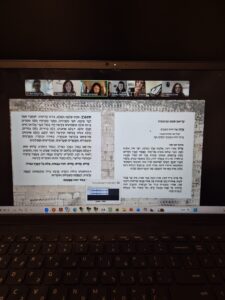 “This morning, I took part in the Rosh Chodesh Nissan prayer with Women of the Wall. Due to the war, the prayer was held on Zoom rather than at the Western Wall. Even so, it was deeply moving.
Both of my children are currently serving in combat roles in the IDF—one in regular service and one in the reserves. I was especially moved while reciting the prayer for the safety of IDF soldiers, and singing Hatikvah, “to be a free nation in our land,” carried profound meaning at this time of war and in light of the current political situation.”
More personal reflections come from Arzenu Olami’s Executive Director, Dekel Houmash, who writes:
“Since the war with Iran began on February 28, 2026, daily life has meant constant runs to shelters and protected spaces. I am among those who do not have a safe room at home, so every siren sends me running outside to the nearest shelter—sometimes every hour, including during the night. Just yesterday, interception fragments fell within a short walking distance from where I live. Despite this difficult reality, we continue the important work following the Congress and do our best to maintain our activities and represent our values in the various arenas. I would also like to thank our friends overseas who reached out with concern—their words mean a great deal and strengthen our resilience.”
Shoshana Dweck, Co-chair of Arzenu Olami, said, “Just a few months after the World Zionist Congress, we are delighted to see real tangible results in the National Institutions, particularly at a time of war when their work is more important than ever. At the same time, we hear the difficulties that our staff are going through on a personal level at this time. We send our support and solidarity to them all”.